

Mayer.xiao
Laser Sensor Solution
How to Connect an ESP32 with a Laser Rangefinder Module for Drone and Robotics Projects
If you're building an autonomous drone, a small ground robot, or an obstacle avoidance system, an ESP32 paired with a laser rangefinder module can provide reliable distance measurements while keeping power consumption low.Compared with ultrasonic sensors, laser distance sensors offer longer measuring ranges, higher accuracy, and much better performance under outdoor lighting conditions. In this guide, I'll show a simple way to connect an ESP32 to a UART laser rangefinder module and read distance data for your own projects.
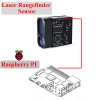
Why Use ESP32?
ESP32 has become one of the most popular development boards for DIY robotics because it provides:- Built-in Wi-Fi and Bluetooth
- Multiple UART interfaces
- Low power consumption
- Easy programming with Arduino IDE
- Large open-source community
Hardware Required
You'll need:- ESP32 development board
- UART laser rangefinder module
- Jumper wires
- USB cable
- Optional breadboard
Wiring Diagram
Typical connections are straightforward.| Laser Module | ESP32 |
|---|---|
| VCC | 5V or 3.3V (according to module specification) |
| GND | GND |
| TX | RX2 (GPIO16) |
| RX | TX2 (GPIO17) |
Arduino Example Code
Using HardwareSerial makes communication simple.
Code:
#include <HardwareSerial.h>

HardwareSerial LaserSerial(2);

void setup() {
  Serial.begin(115200);
  LaserSerial.begin(115200, SERIAL_8N1, 16, 17);
}

void loop() {
  while (LaserSerial.available()) {
    char c = LaserSerial.read();
    Serial.print(c);
  }
}Testing the Sensor
After uploading the sketch:- Open Serial Monitor.
- Point the sensor toward a flat object.
- Move the target closer and farther away.
- Verify that distance values change smoothly.
- Double-check TX/RX wiring.
- Confirm baud rate.
- Verify power supply voltage.
- Make sure the module has entered measurement mode.
Applications in Drone Projects
An ESP32 combined with a laser rangefinder module can be useful for many UAV applications.Altitude Measurement
Measure low-altitude height during landing or hovering where GPS accuracy becomes limited.Obstacle Detection
Detect walls, trees, poles, or indoor obstacles during autonomous flight.Payload Positioning
Measure the distance between a drone and a landing platform or delivery target.Ground Robots
The same hardware setup also works well for AGVs, warehouse robots, and indoor navigation systems.Improving Measurement Reliability
A few practical tips can improve performance.- Avoid measuring transparent surfaces.
- Keep the sensor lens clean.
- Reduce vibration when mounting on drones.
- Use averaging or filtering for smoother readings.
- Ensure sufficient power during wireless transmission.
Choosing the Right Laser Rangefinder Module
Different projects require different specifications.Consider:
- Measuring range
- Accuracy
- Measurement frequency
- Interface (UART, RS232, RS485)
- Module size
- Power consumption
- Outdoor performance
Final Thoughts
Connecting a laser rangefinder module to an ESP32 is surprisingly simple and opens the door to many robotics and UAV applications. Once the UART communication is working, integrating the distance data into navigation, obstacle avoidance, or automation logic becomes much easier.If you're looking for more information about compact industrial laser distance sensors or need communication examples for ESP32, Arduino, or Raspberry Pi, you can find additional technical resources here:Laser Distance Sensor -Laser Sensor Solutions-Meskernel
The documentation includes interface descriptions, communication protocols, and integration examples for various embedded platforms.